
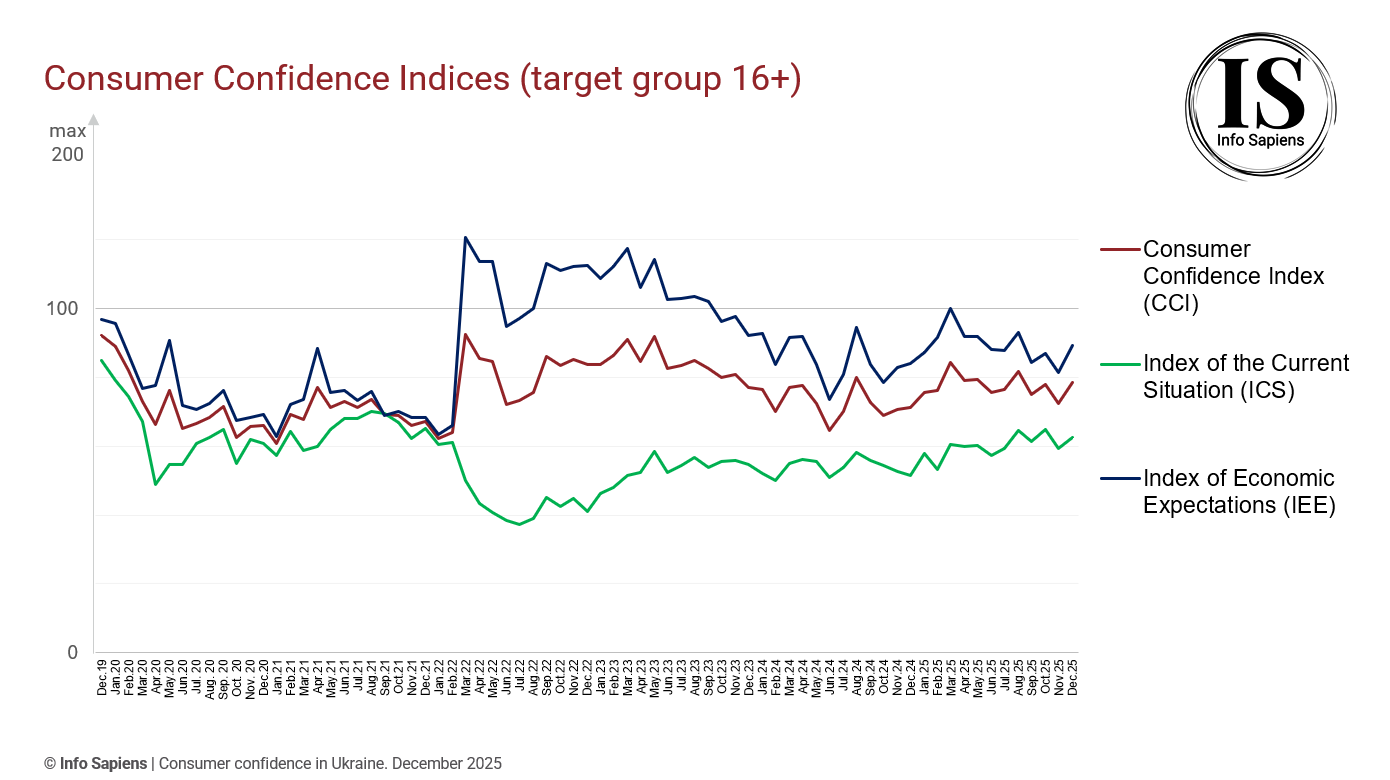
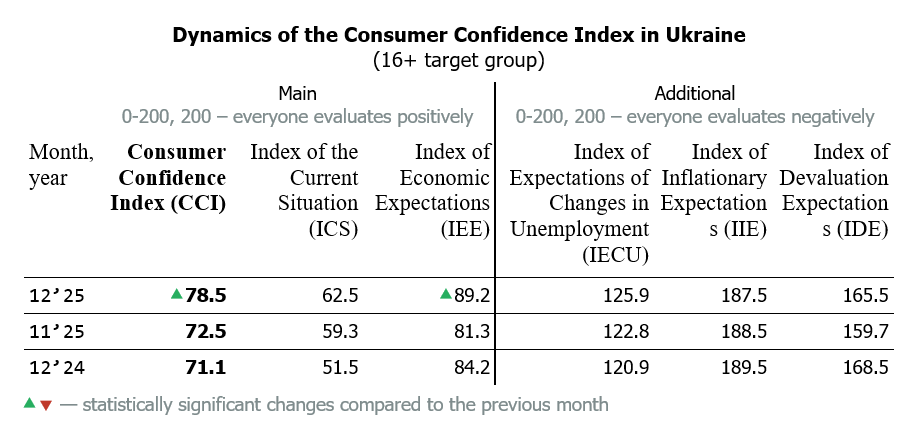
According to the data provided by Info Sapiens “Consumer confidence of Ukrainians” in December, 2025, the Consumer Confidence Index of Ukrainians has increased by 6 points and equals 78,5 points. All components of the indicator increased.
In December 2025, the Consumer Confidence Index (CCI) equals 78,5 p., which is 6 points higher than the indicator in November.
Index of the Current Situation (ICS) has increased and equals 62,5 p., which is 3,2 p. higher than in November. The components of this index have changed as follows:
- – Index of Current Personal Financial Standing (х1) increased by 4,9 p. and equals 58,2 p.;
- – Index of Propensity to Consume (х5) increased by 1,5 p. and equals 66,9 p.
In December, Index of Economic Expectations (ІЕE) increased by 7,9 p. and equals 89,2 p. The components of this index have changed as follows:
- – Index of Expected Changes in Personal Financial Standing (х2) equals 88,4 p., which is 2,4 points higher than in November;
- – Index of Expectations of the Country’s Economic Development Over the Next Year (х3) in December equals 74 p., which is 10,9 points higher than in previous month;
- – Index of Expectations of the Country’s Economic Development over the Next 5 Years (х4) increased than in previous month by 10,3 points and equals 105,3 p.
In December, the indicator of Index of Expectations of Changes in Unemployment Expectations increased by 3,1 point and equals 125,9 p. Index of Inflationary Expectations decreased by 1 point and equals 187,5 p. Index of Devaluation Expectations increased by 5,8 p. and equals 165,5 p.
«After the decline in November, the Consumer Confidence Index showed a noticeable recovery in December 2025, increasing by 6 points to 78.5. Growth was recorded across all components of the indicator, reflecting improved evaluation of both the current situation and economic expectations. At the same time, the increase in expected unemployment dynamics and devaluation expectations indicates that consumer caution persists. Overall, the December rise in the Consumer Confidence Index may point to a temporary rebound in optimism at the end of the year.» - as Info Sapiens analysts comment.
Survey information
The study of the Consumer Confidence Index in Ukraine was conducted by GFK UKRAINE since June 2000, and since 2019 it has been carried out by INFO SAPIENS LLC.
In Ukraine, the Consumer Confidence Index is determined through a random survey of domestic households. During the poll, 1,000 people aged 16 and over are interviewed. The structure of the sample corresponds to the structure of the population according to such parameters as gender, age, size of the settlement, and region according to the latest available data of the State Statistics Service of Ukraine before the full-scale invasion of russia on February 24, 2022. The "Consumer Confidence" study is not conducted in the Autonomous Republic of Crimea, the city of Sevastopol, as well as other territories of Ukraine temporarily occupied by russia, where Ukrainian operators do not provide mobile phone services. Also, the survey does not include Ukrainians who went abroad. The margin of error does not exceed 3.1%. In April and May 2020, as well as in April 2021, due to COVID-19, and from March 2022, the survey was conducted by telephone interview with calls to mobile numbers. Dates of the latest survey: December 17-26.
To define the CCI, respondents are asked these questions:
- 1. How has the financial standing of your family changed over the last six months?
- 2. How do you think your family’s financial standing will change in the next six months?
- 3. Looking at economic conditions in the country as a whole, do you think the next 12 months will be good or bad?
- 4. Looking at the next five years, will they be good ones or bad ones for the country’s economy?
- 5. In terms of large purchases for your home, do you think now is generally a good time or a bad time to make such purchases?
- • index of Current Personal Financial Standing (x1);
- • index of Expected Changes in Personal Financial Standing (x2);
- • index of Expected Economic Conditions in the Country Over the Next Year (x3);
- • index of Expected Economic Conditions in the Country Over the Next 5 Years (x4);
- • index of Propensity to Consume (x5).
- • consumer Confidence Index (CCI) as the arithmetic average of indices x1–x5;
- • index of the Current Situation (ICS) as the arithmetic average of indices x1 and x5;
- • index of Economic Expectations (IEE) as the arithmetic average of indices x2, x3, and x4.
- 1. Do you think that within next 12 months the number of unemployed (people who do not have job and are looking for work) will increase, will remain roughly the same, or will decrease?
- 2. How do you think that prices for major consumer goods and services will change in the next 1–2 months?
- 3. How do you think the USD value will change towards the UAH value during the next 3 months?
Each of these questions is related to a corresponding index:
Indices are constructed thus: the share of negative answers is deducted from the share of positive answers, and 100 is added to this difference in order to eliminate negative values. On the basis of these five indices, three aggregate indices are calculated:
Index values range from 0 to 200. The index equals 200 when all respondents positively assess the economic situation. It totals 100 when the shares of positive and negative assessments are equal. Indices of less than 100 indicate the prevalence of negative assessments. To determine the Index of Expected Changes in Unemployment (IECU), the Index of Inflationary Expectations (IIE) and the Index of Devaluation Expectations (IDE), the respondents are asked these three questions:
The IECU, the IIE and the IDE are calculated thus: the share of answers that indicate a decrease of unemployment/inflation/devaluation is subtracted from the share of answers that indicate the growth of unemployment/inflation/devaluation, and 100 is added to the difference to eliminate negative values. The values of indices can vary from 0 to 200. The index totals 200 when all residents expect an increase in unemployment/inflation/devaluation.